
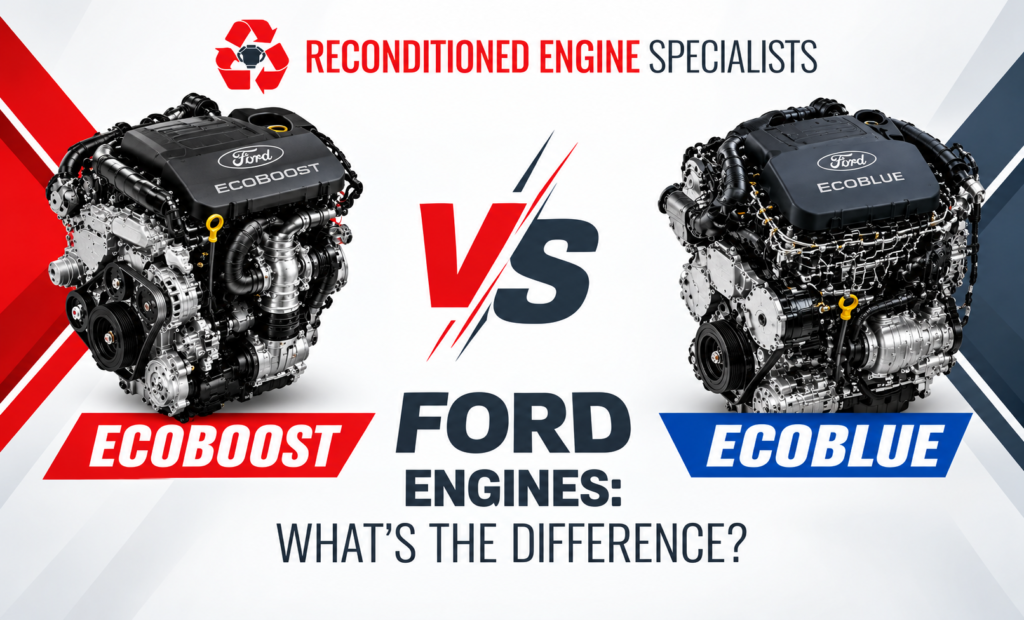
Ford EcoBoost vs EcoBlue Engines: What’s the Difference?
Choosing between Ford EcoBoost and EcoBlue engines depends on your driving needs, fuel preference and vehicle usage. Both engine families are designed to balance performance and efficiency, but they use different fuels and suit different types of driving. At Reconditioned Engine Specialists, we understand that knowing the difference between these engines can help you make an informed decision about engine maintenance, repairs and replacement.
What Is a Ford EcoBoost Engine?
Ford EcoBoost is a family of turbocharged petrol engines designed to deliver responsive performance alongside improved fuel efficiency. These engines use turbocharging and direct fuel injection to produce useful power from relatively small engine capacities. EcoBoost engines are commonly associated with passenger cars and SUVs. Depending on the engine version, they can offer responsive acceleration, smooth performance and a balance between everyday usability and power. However, maintenance remains important. Certain variants may experience timing belt wear, coolant leaks, turbocharger faults or other mechanical problems. The exact risks depend on the engine design, manufacturing year and service history.
What Is a Ford EcoBlue Engine?
Ford EcoBlue is a family of modern turbocharged diesel engines developed with fuel efficiency, torque and everyday working performance in mind. EcoBlue engines are used in a range of Ford passenger vehicles and commercial vehicles. Diesel engines generally produce strong low-speed torque, making them suitable for carrying loads, motorway driving and demanding working conditions. This is one reason EcoBlue engines are popular in vans and other commercial applications. Like other modern diesel engines, EcoBlue variants may use emissions-control equipment such as a diesel particulate filter (DPF), exhaust gas recirculation (EGR) and, depending on the application, an AdBlue system. Potential problems include DPF blockage, EGR faults, turbocharger wear, fuel injection issues and timing system concerns on certain variants. Proper servicing and the correct engine oil are essential.
Ford EcoBoost vs EcoBlue: Main Differences
| Feature | Ford EcoBoost | Ford EcoBlue |
|---|---|---|
| Fuel type | Petrol | Diesel |
| Engine design | Turbocharged petrol | Turbocharged diesel |
| Driving character | Responsive acceleration | Strong low-speed pulling power |
| Typical use | Cars and SUVs | Vans, commercial vehicles and some cars |
| Fuel economy | Depends on engine and driving style | Often advantageous on longer journeys |
| Short journeys | Generally suitable, subject to normal use | Repeated short trips can affect DPF regeneration |
| Maintenance | Petrol-specific servicing and timing-system checks | Diesel servicing and emissions-system maintenance |
| Common concerns | Timing system, cooling system and turbo faults on certain variants | DPF, EGR, injection, turbo and timing-system faults on certain variants |
Actual performance, fuel consumption and reliability vary by engine generation, capacity, vehicle and maintenance history.
Which Engine Is Better for Fuel Economy?
EcoBlue diesel engines can be an economical choice for drivers who regularly cover long distances, travel on motorways or operate commercial vehicles. Diesel engines often deliver better fuel economy under these conditions, although the result depends on the particular vehicle and engine. EcoBoost petrol engines can be a practical choice for everyday driving, particularly when journeys are shorter or annual mileage is lower. They also avoid diesel-specific DPF regeneration requirements. When comparing fuel costs, consider annual mileage, fuel prices, servicing, repair costs and the type of journeys you regularly make rather than relying on fuel economy figures alone.
Which Engine Is Better for Performance?
EcoBoost engines generally offer responsive petrol performance, with turbocharging helping provide acceleration when needed. Depending on the variant, they can suit urban driving, everyday commuting and more performance-focused applications. EcoBlue engines typically provide strong low-rev torque, which is particularly useful when carrying equipment, transporting goods or driving a loaded van. Neither engine family is universally better. The right choice depends on the engine specification, vehicle weight, intended use and your driving habits.
Common Ford EcoBoost Engine Problems
Some EcoBoost engines may develop faults as they age or if maintenance is neglected. Potential warning signs include:
- Unexplained coolant loss or overheating
- Engine rattling or unusual mechanical noises
- Loss of power or poor acceleration
- Excessive exhaust smoke
- Misfiring or rough running
- Oil pressure warnings
Certain EcoBoost engines use a belt-in-oil timing system, while others use different timing arrangements. Always confirm the exact engine variant before deciding which maintenance procedure or repair is required.
Common Ford EcoBlue Engine Problems
EcoBlue engines can also develop faults that require professional inspection. Common areas to investigate include:
- DPF blockage or regeneration problems
- EGR valve faults
- Turbocharger problems or reduced boost
- Injector or fuel-system faults
- Timing belt wear on applicable versions
- Oil pressure issues or internal engine wear
Warning lights, unusual noises, starting difficulties and reduced engine performance should be investigated promptly. Continuing to drive with a serious engine warning can increase the risk of further damage.
Engine Repair, Reconditioning or Replacement?
If your Ford engine develops a serious fault, the best option depends on the cause of the problem and the engine’s overall condition.
Engine repair: A suitable option when the fault is limited to a component and the remaining engine is in good condition.
Engine reconditioning: May be appropriate when internal components require refurbishment and the engine is suitable for rebuilding.
Engine replacement: Worth considering when internal damage is extensive, repair costs are uneconomical or a suitable replacement offers better overall value. Before making a decision, obtain a proper diagnosis and compare the cost of repairs with the cost of a replacement engine, including fitting and any additional components required.
Choosing the Correct Replacement Ford Engine
Finding the correct replacement engine involves more than matching the EcoBoost or EcoBlue name. Engine capacity, engine code, production year, power output, emissions specification and vehicle compatibility can all affect whether an engine is suitable. Always verify compatibility using the vehicle registration, VIN and engine code where appropriate. This helps reduce the risk of ordering an incompatible unit. Reconditioned Engine Specialists can help customers looking for engine replacement and reconditioned engine options. Contact our team to discuss your requirements and establish which engine specification is suitable for your vehicle.
Frequently Asked Questions
Is EcoBoost petrol or diesel?
EcoBoost is Ford’s turbocharged petrol engine family.
Is EcoBlue petrol or diesel?
EcoBlue is Ford’s diesel engine family, used across selected passenger and commercial vehicles.
Is EcoBlue more economical than EcoBoost?
EcoBlue may offer better fuel economy on longer journeys, while EcoBoost may suit lower-mileage and shorter-trip driving. Actual results depend on the vehicle, engine and driving conditions.
Are Ford EcoBoost and EcoBlue engines reliable?
Both can provide dependable service when correctly maintained. Reliability depends on the specific engine version, servicing, driving conditions and any known design-related issues.
Can I replace an EcoBoost engine with an EcoBlue engine?
A direct replacement is not normally a simple swap because petrol and diesel engines differ in their fuel systems, electronics, emissions equipment and other components. Any conversion requires detailed compatibility and legal checks.
Speak to Reconditioned Engine Specialists
Understanding the difference between Ford EcoBoost and EcoBlue engines can help you choose the right approach to maintenance, repair or replacement. Whether you need advice about a petrol engine, a diesel engine, a reconditioned unit or engine supply and fitting, contact Reconditioned Engine Specialists to discuss your requirements.
Looking for a replacement engine? Get in touch with our team to discuss suitable options for your vehicle.